Forecasting: Directions, Progressions, Transits, Returns
Predictive astrology from the Hellenistic and medieval traditions to modern and Vedic methods, with the ability to combine and compare the results of several techniques in a single timeline.
AstroApp includes the predictive techniques of traditional and modern astrology, from primary directions to transits and time lords (chronocrators). Each technique gives you a list of hits, with the ability to calculate a chart for the moment of a hit. The Events Manager combines the hits of several techniques on one timeline. The time lord systems of the Hellenistic and Medieval traditions are included along with the Vedic dashas, and all of them can be combined on the Time Map.
Primary Directions
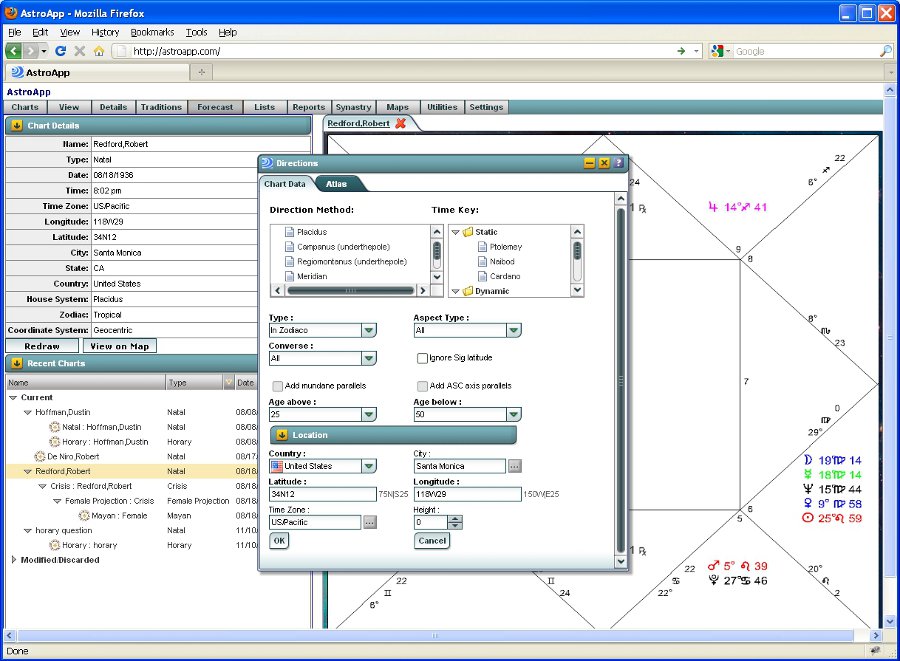
You can calculate primary directions with 14 methods: Placidus, Campanus under the pole, Regiomontanus under the pole, Meridian, Morinus, Porphyry, Alcabitius, Koch, Topocentric, Horizontal, equal houses on the ecliptic, equal houses on the hour circle, directions in longitude, and the primaries of Edmund Jones. You can choose from 27 time keys:
- static keys: Ptolemy, Naibod, Cardano, Umar al-Tabari, Wöllner and Plantiko
- dynamic keys: Placidus, Simmonite, the symbolic solar arc, the Ascendant arc, the vertical arc, Kündig, Kepler, Brahe and Giuseppe Bezza's true Sun in Right Ascension
- symbolic keys: the symbolic degree, year, month and week, the synodic symbolic key, the duodenary, sub-duodenary, quarterly, quinary and novenary keys, the symbolic Moon average and the self-measure
You can calculate directions in mundo, in zodiaco or in the field plane, as direct, traditional converse or neo-converse directions, between angles, planets and fixed stars. You can also:
- restrict aspects to dexter or sinister
- exclude latitude, or reduce the Promissor's latitude according to the rules of Gouchon or Bianchini, or by house position
- start from Gouchon's preset
- calculate mundane parallels on the Ascendant and MC axes
- add the lunar parallax correction
- switch between the true and the apparent positions of Promissors and Significators
Progressions
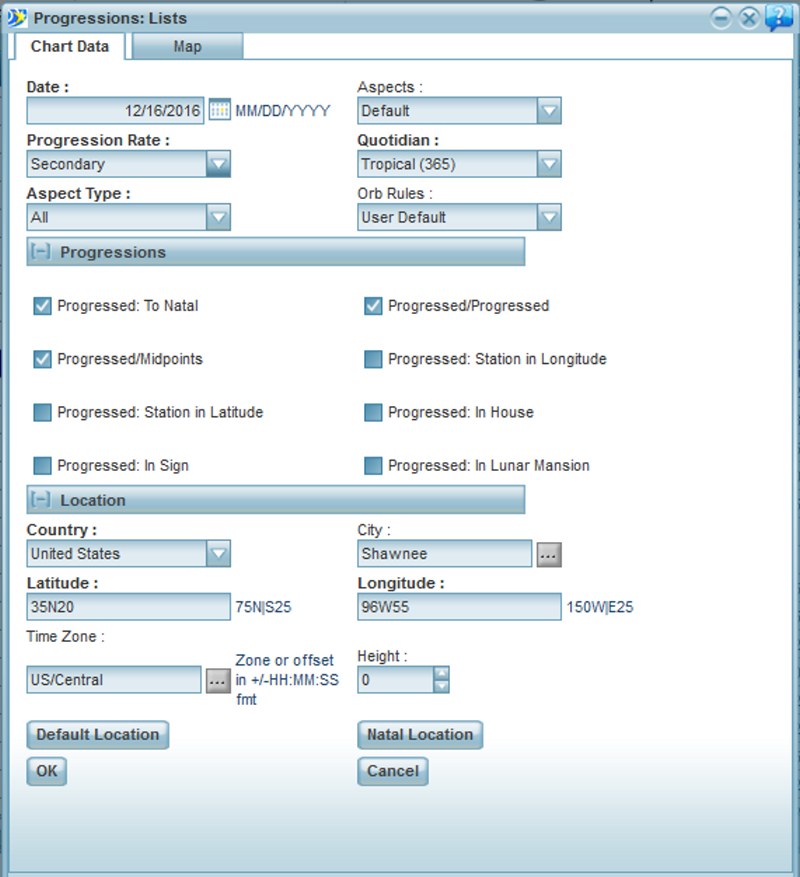
You can use 24 progression rates and see the results as progressed charts, as listings or as linear graphs in longitude, latitude and declination. The rates include:
- secondary, tertiary and minor progressions
- Charles Jayne's progressions in declination
- the solar day against the perigee year, the eclipse year, and the tropical, synodic, draconic and perigee months
- the sidereal day against the sidereal, perigee and eclipse years and the sidereal, synodic, perigee and draconic months
- the duodenary, sub-duodenary, septenary, quinary and self-measure rates, and one symbolic degree a year
For the progressed MC you can choose the mean quotidian, the true or mean solar arc in longitude or in RA, the Cardano mean solar arc, one degree a year, or keep the natal MC. The listings show progressions to radix points and to natal midpoints, progressed to progressed hits, progressed stations in longitude and latitude, and progressed ingresses into signs, houses and tropical lunar mansions. All calculations can be done in geocentric, heliocentric or topocentric coordinates.
Transits
Transit lists show transit to natal and transit to transit hits, transits to house cusps, and stations in longitude and latitude. You can filter aspects by dexter and sinister, by orb or by percentage, or show partile aspects only, using any of the aspect sets in your settings. Other transit tools:
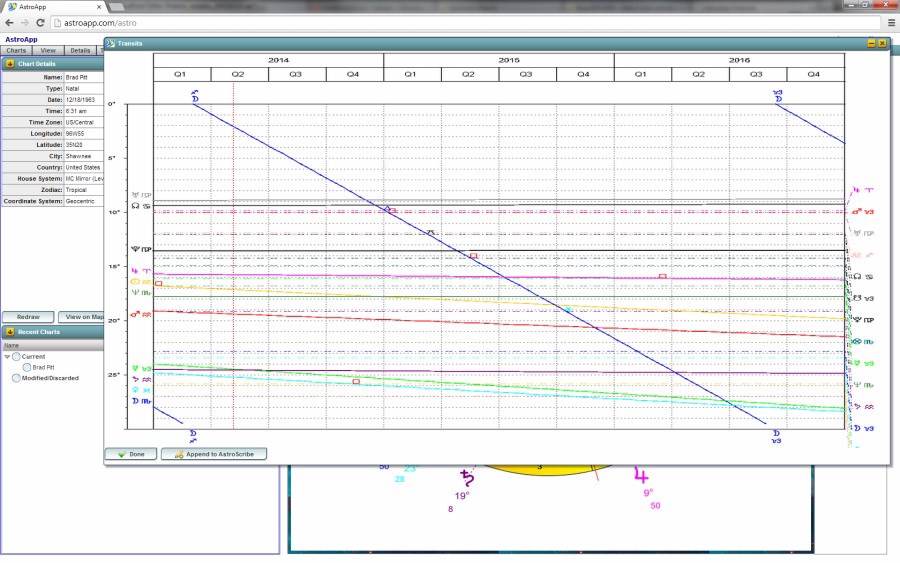
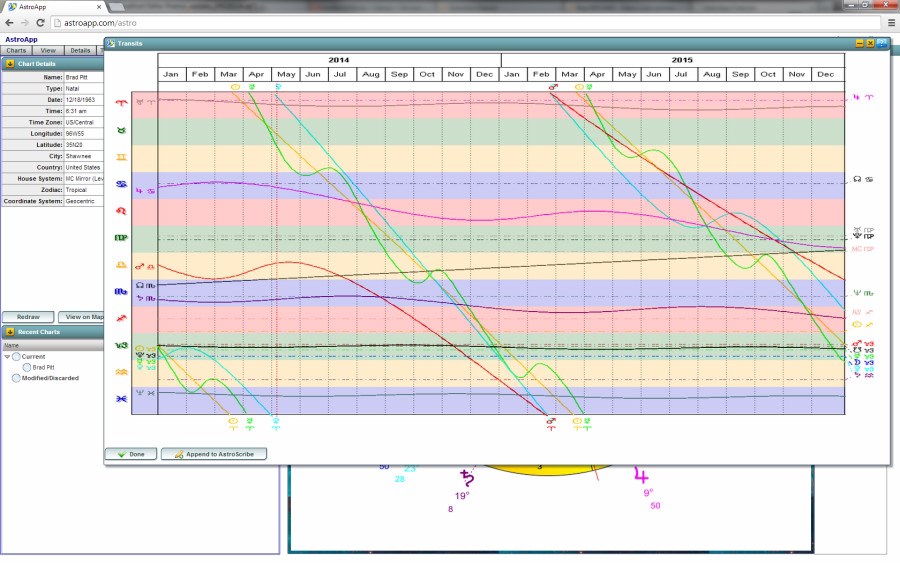
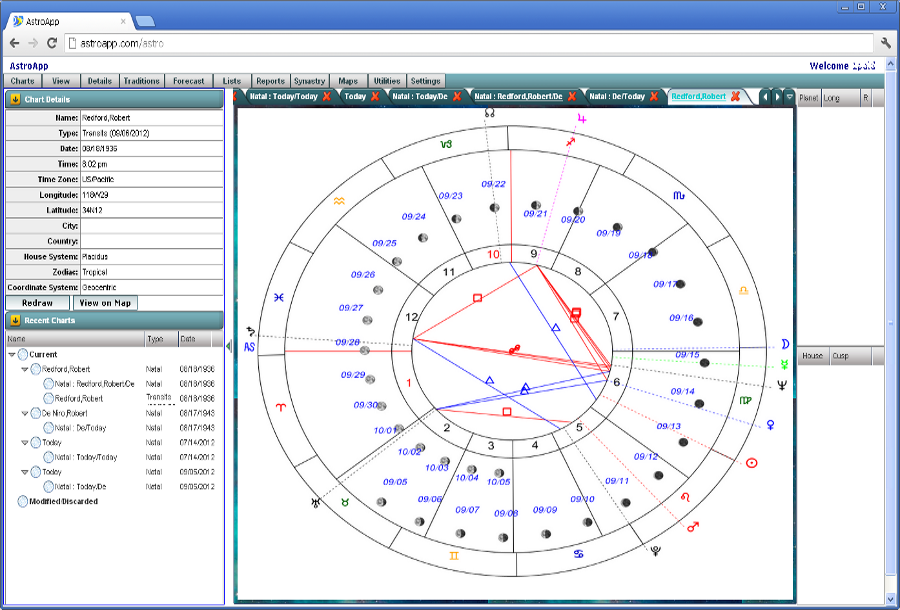
- linear transits in the 12-sign zodiac, the 13 Signs zodiac and the natal houses, with heliocentric and topocentric options
- Ebertin-style transits, and the Dynamic Transit Wheel, which moves the transiting planets over the chart
- circular transits, known as time tunnels: lunar days, monthly transits for the luminaries, planets and major asteroids, and monthly transits with the lunar phases
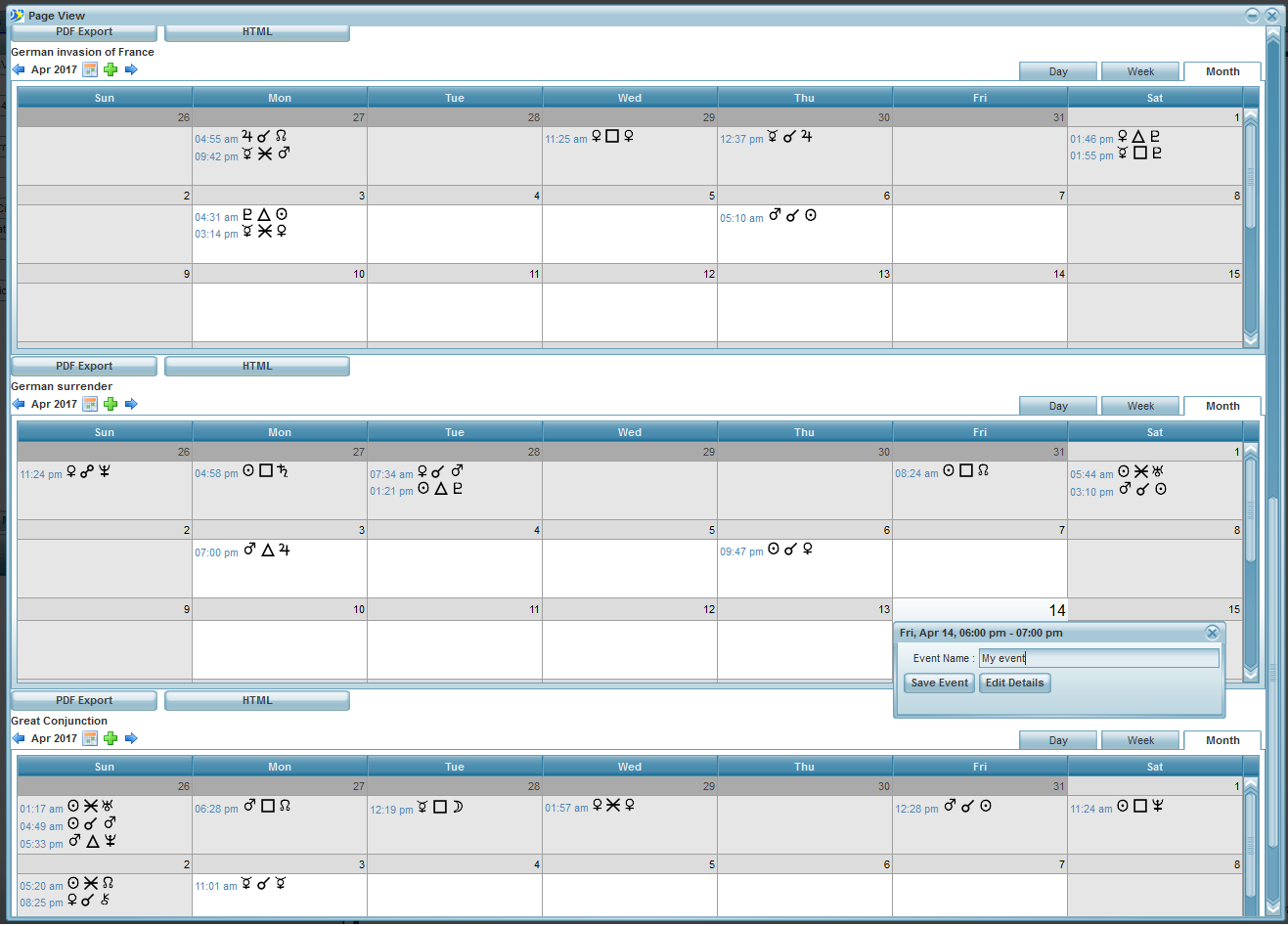
- dual chart transits, and transits for a group of charts on one calendar, with print preview and PDF export
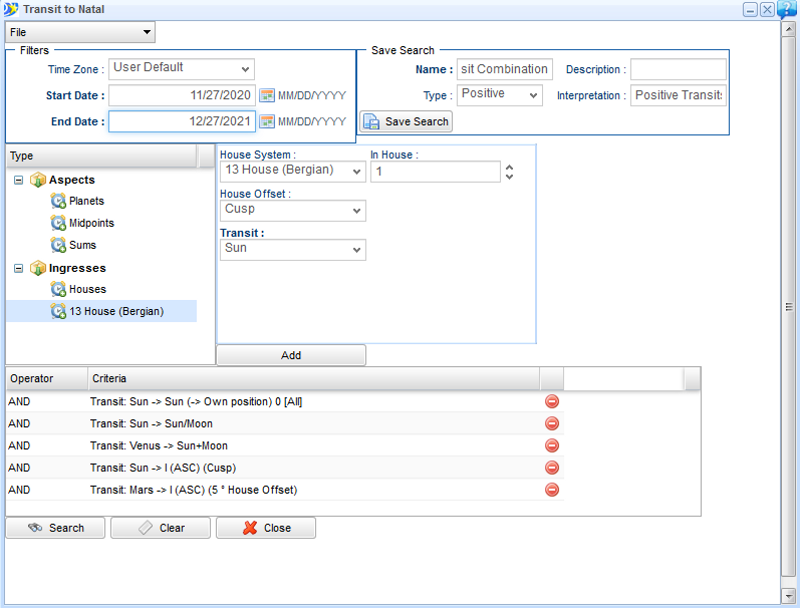
- the Events Search, which finds transits to natal planets, midpoints and planetary sums, ingresses into houses, transits over the middle of a house or five degrees before a cusp, and times when a planet changes direction
- saved searches, which you can rate and create your own interpretation for
- planetary cycles
Returns
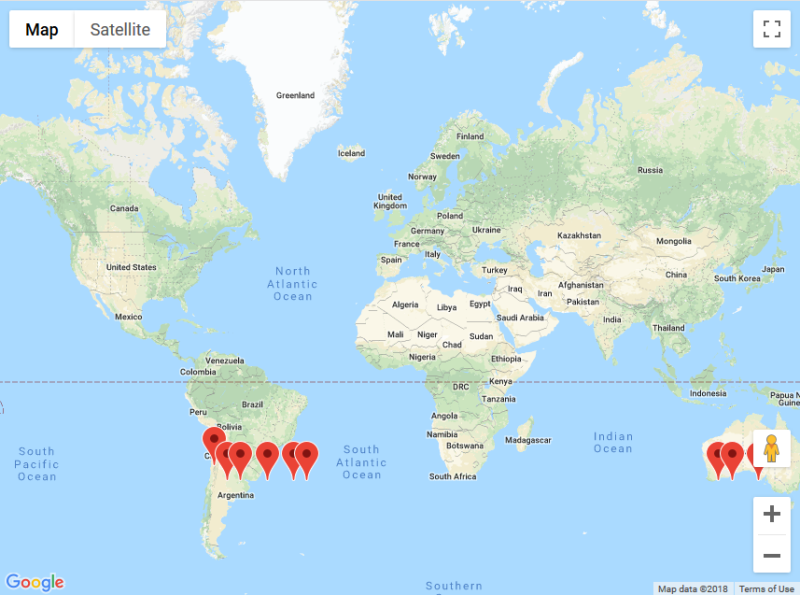
You can calculate solar, lunar and planetary returns, both direct and converse, for any location, with or without precession. The Returns Scanner finds the best place on Earth for a return, known as an aimed return. Types of returns:
- returns for the major asteroids, and personal returns
- phase returns, the embolismic lunar returns and planetary phase returns
- kinetic returns
- Solar and Lunar returns using the Wynn key
- solunars and anlunars, tropical or sidereal
- harmonic returns: demi-returns, quarter returns, ennead returns and so on
- returns to any degree of the zodiac, to house cusps, to planets and to the major asteroids
- solar return distributions, with and without precession
- Returns Animation
- Returns Locations Scanner
Solar and Planetary Arcs
You can create Solar, Lunar and Planetary Arcs charts for the Sun, Moon, all the planets and the major asteroids, and for the Ascendant, MC, Vertex and lunar nodes. Choose from 24 rates and 4 quotidians, or enter your own Arc rates. Arcs in declination follow the method of Charles Jayne and Eleanor Heseltine. The Solar Arcs table lists the hits with planets, house cusps and special objects. You can save every hit as a chart-specific event and add the event dates to the database.
Persian directions, periodic directions and Dom Néroman's evolutive directions are also included. The Direction Figure, based on the work of Giuseppe Bezza and Danièle Jay, shows the whole chart directed to any date, with the directions in mundo and in zodiaco that fall due around it.
Ingresses
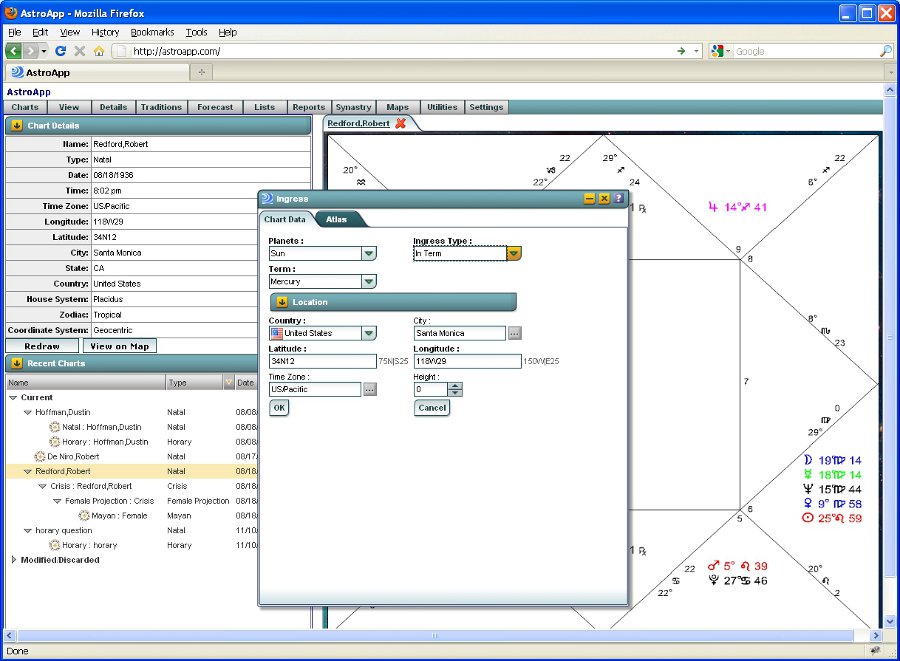
AstroApp lists the ingresses of any planet or major asteroid into the signs, the terms (bounds) of your chosen bounds system, the houses, the lunar mansions and the nakshatras. You can calculate a chart for each ingress in one click. Ingresses into the tropical lunar mansions come with Bob Makransky's interpretations.
Animation
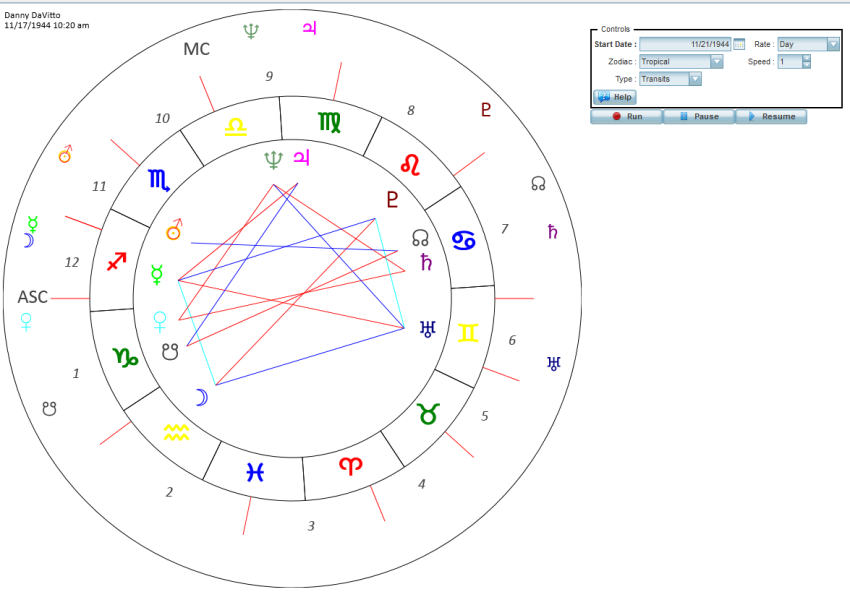
You can animate transits, and Western and Vedic progressions using any of the 24 available progression rates. The returns of the luminaries and planets can be animated as well. The animation can run through the tropical, sidereal, 13 Signs and galactic zodiacs, and through the lunar mansions and nakshatras. The animation speed is also configurable (by day, week, month or year).
Time Lords and the Time Map
Each of the Hellenistic Chronocrators, Medieval Time Lords and Vedic dashas includes:
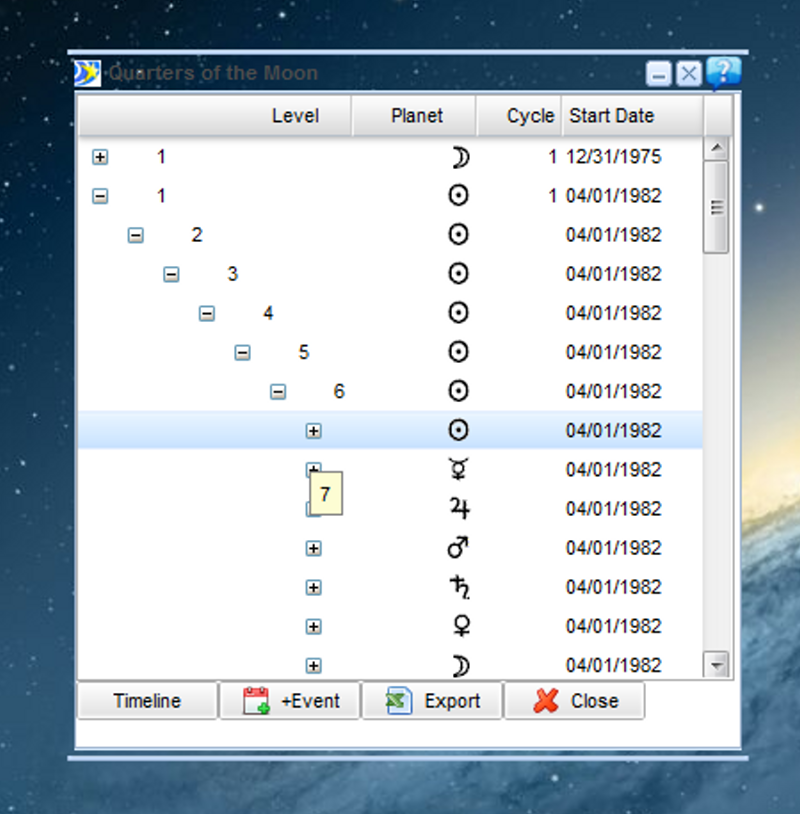
- a tree of periods and sub-periods down to eight levels
- a timeline
- a table you can export to Excel and PDF
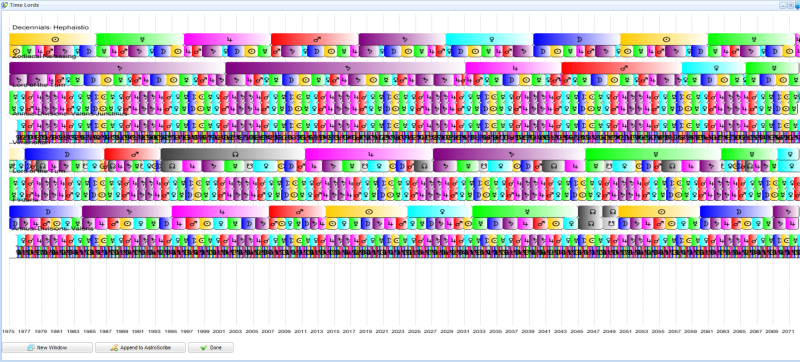
- the Time Map, a linear map that can combine the time lords from any tradition, each with its own calculation settings
You can find the time lord systems themselves in Hellenistic Astrology, Medieval and Traditional Astrology and Vedic Astrology.
Modern Methods and the Events Manager
The modern forecasting methods include the Huber age point, Rudhyar progressions, the developmental ages, and the Life Time module, based on the work of A. T. Mann, with its scale wheel, bi-wheel and events table.
The Events Manager can show events and hits from any of the predictive techniques on one timeline: the hits of primary directions, progressions, transits, time lords, profections, Rudhyar ages and Age Point aspects. You can also add your own custom events.
Frequently Asked Questions
Which primary direction methods and time keys can I use?
You can choose from 14 methods, such as Placidus, Regiomontanus, Campanus, Meridian, Morinus, Porphyry, Alcabitius, Koch, Topocentric, Horizontal, two equal house methods, directions in longitude and Edmund Jones, and 27 time keys: static, dynamic and symbolic.
Can I direct to fixed stars?
Yes. You can use fixed stars as Promissors and Significators in primary directions.
How many progression rates can I use?
24, from the secondary and tertiary rates to the sidereal day and month ratios and the symbolic rates. All of them are also available for arcs and animation.
Can I find the best place to celebrate my Solar Return?
Yes. The Returns Scanner searches the World for the places where a return meets your desired criteria. It works for Solar, Lunar and every other type of return.
Can I see the forecasts of several charts together?
Yes. You can draw a transit calendar for a group of charts. For a single chart, the Events Manager and the Time Map combine the hits from any number of techniques.
See Also
- Tutorial 3: progressing the chart
- Interpretation of Transits, an article written by Bob Makransky
- Hellenistic Astrology, Medieval and Traditional Astrology and Research, for the advanced transit search