Medieval and Traditional Astrology Software
The tradition of the Arabic, Persian and Latin astrologers of the Middle Ages and the Renaissance.
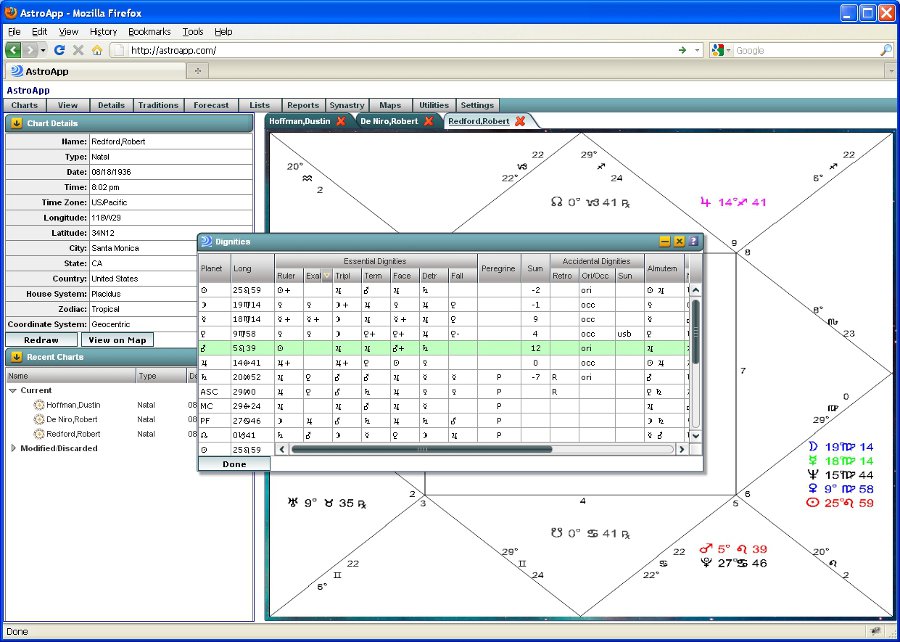
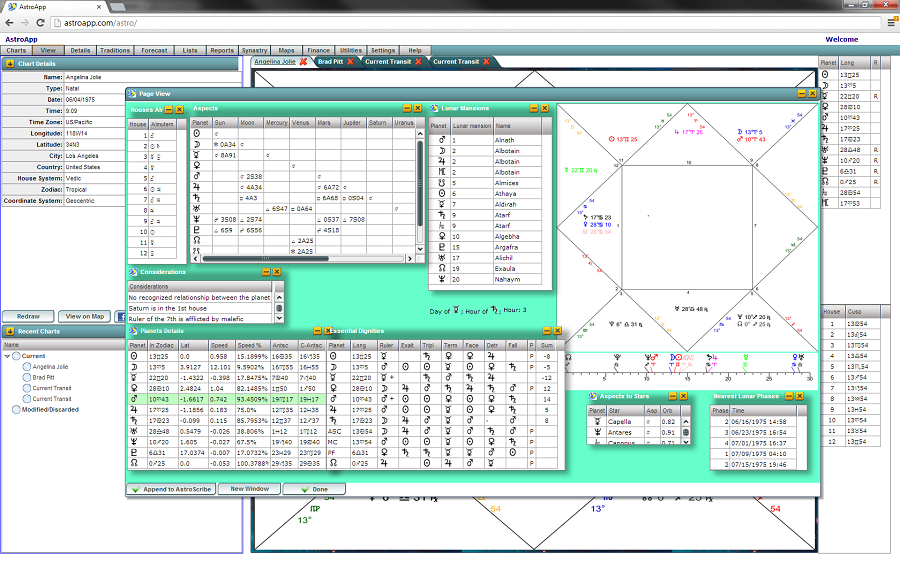
AstroApp includes the working tools of the Arabic, Persian and Latin astrologers: dignities and debilities with the terms, triplicity and decan systems of your choice, receptions and planetary relationships, lunar mansions and lunar days, almutens, Arabic parts, temperament, and the predictive methods from firdaria to the directions through the bounds. The predefined Traditional Page shows most of them together with the chart, so everything a traditional reading needs is on one screen.
Dignities and Qualities
The dignities table scores every planet and house cusp according to the systems you choose in your settings:
- terms of the Egyptian, Chaldean (by day and by night), Valens, Hephaistio, Vedic and Iberian systems, and Ptolemy's terms in three versions: the Loeb translation, Lilly's table and the critical edition
- Dorothean and Ptolemaic triplicities, with the rulership sequences by sect; classical and Chaldean decans
- three scoring systems, including Christopher Warnock's system
- combustion rules customization
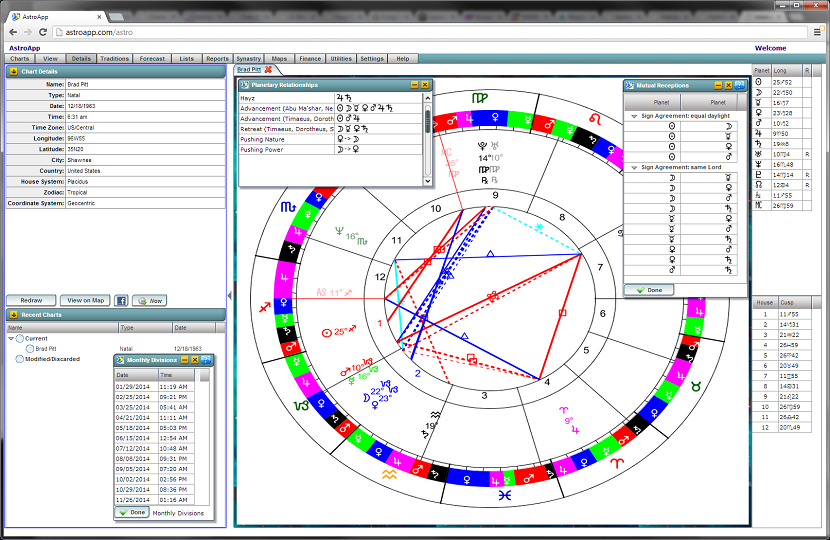
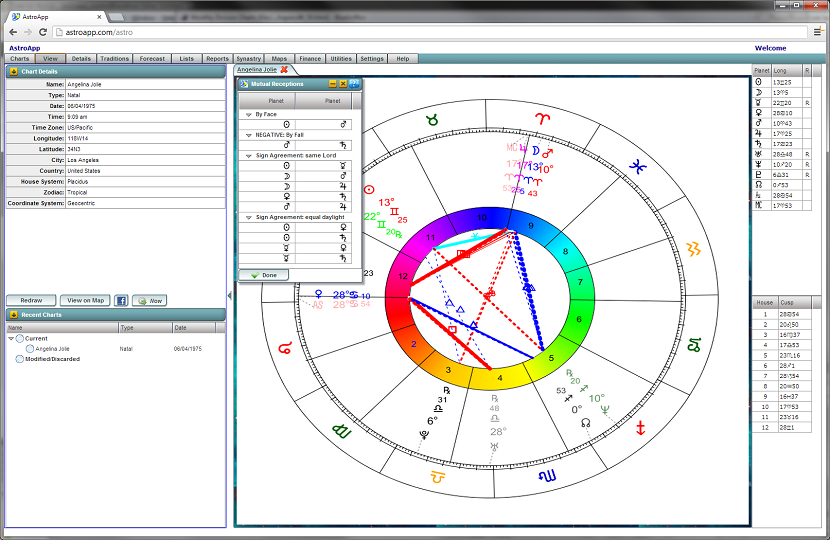
- mutual receptions, positive and negative
- planetary relationships: generosity, proper receptions, pushing nature, pushing power, retreat, advancement, hayz and others
- degree qualities: joy, almugea, azemene, the degrees of sex, fortune and illness, and many more
- sect details, the lord of the geniture, the syzygy, the dispositor chains and the ascensional times of the signs
- chart statistics based on the traditional dignities and the elements, and a list of whole sign aspects
Temperament, Hyleg and the Chart Details
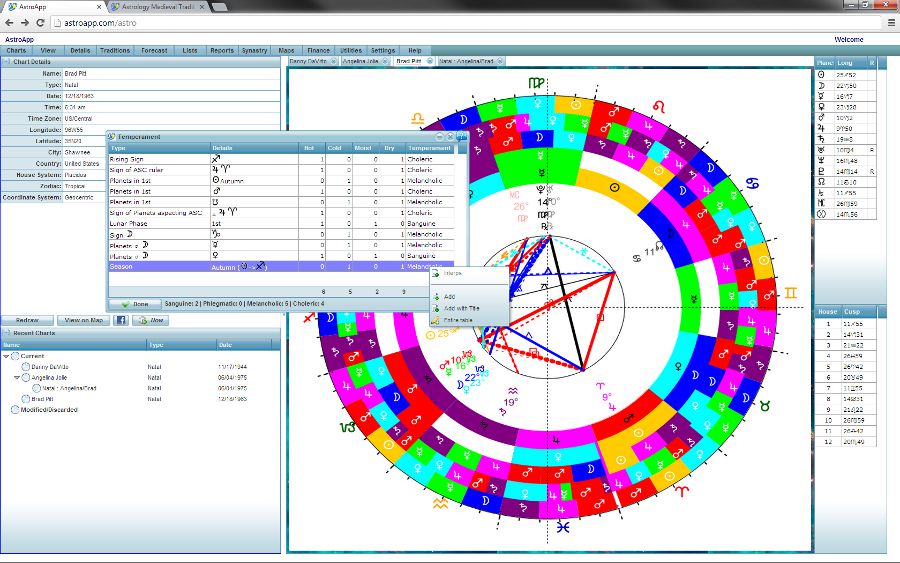
AstroApp has multiple methods of temperament calculation (traditional, and according to John Frawley). You can also define your own calculation protocols for temperament and any other area using the Almuten Designer. The chart details show the lord of the geniture, the hyleg according to Bonatti's rules and 10 other methods, the alcocoden according to Bonatti and Zoller, the syzygy, and whether the chart is preventional or conjunctional. You can also use the traditional protocols: temperament, the essential and accidental dignities, slavery according to Bonatti and Zoller, eminence, and Mashallah's planetary strength from the Persian tradition.
The phases table shows where each planet stands in its cycle with the Sun, in the 16 phases of the medieval authors, from the conjunction through the stations and back. It also shows Cardano's six states of the superior planets, the grades of combustion and under the beams conditions.
The Classical Star Testimony table, based on Ptolemy and the Anonymous of 379, lists the bright fixed stars on the angles of the chart and the bright stars conjunct the Moon. It also shows when the Ascendant, the Sun, the Moon or Venus falls in one of the zodiac places the classical texts associate with the passions or with damage to the sight, and gives the planetary nature of each star.
Almutens
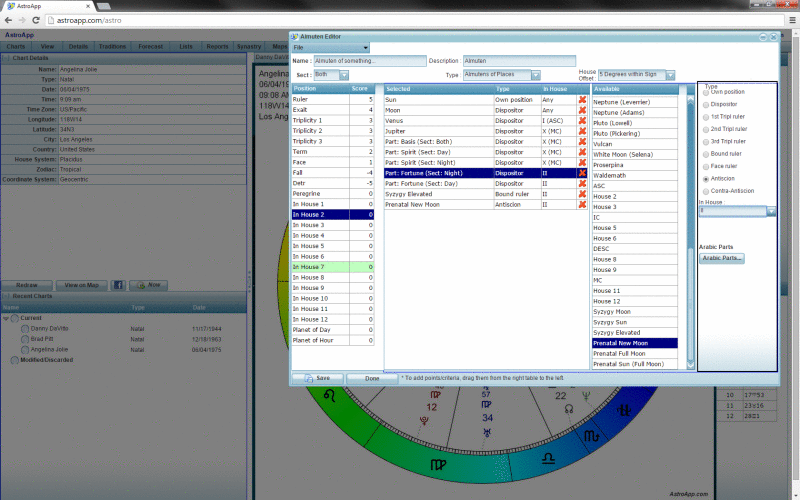
AstroApp calculates 19 topical almutens, including the almuten of the soul according to Montulmo and Ibn Ezra, the almudebit of the chart according to Ibn Ezra and Bonatti, Montulmo's almutem of the chart and his almutens of Mercury, the Ascendant and the Moon, and Omar's almutens of children, travel, profession, friends, enemies, siblings, mother, sexual union, substance and work. With the Almuten Designer you can build your own almutens from the factors you choose. You can base the almuten calculation on one of five systems: Hellenistic, medieval Western, medieval Persian, Renaissance or the magical tradition, with Mashallah's and Ptolemy's scoring among the options.
Arabic Parts
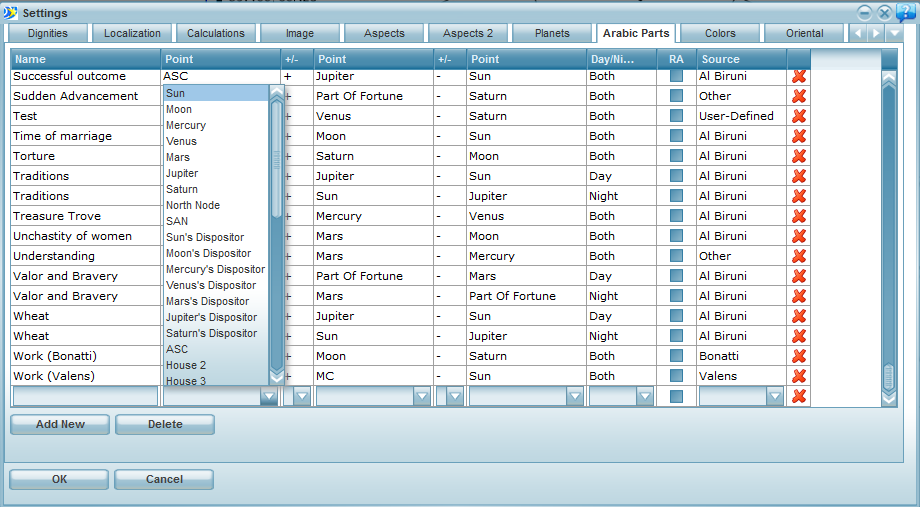
AstroApp calculates 150 Arabic parts and the Hellenistic lots. You can filter the list by name, use formulas of any complexity, and add the parts to your charts and tables. With the Arabic Parts Editor you can create new parts from any objects, including house rulers, dispositors, modern planets, asteroids and special objects.
Lunar Mansions and Lunar Days
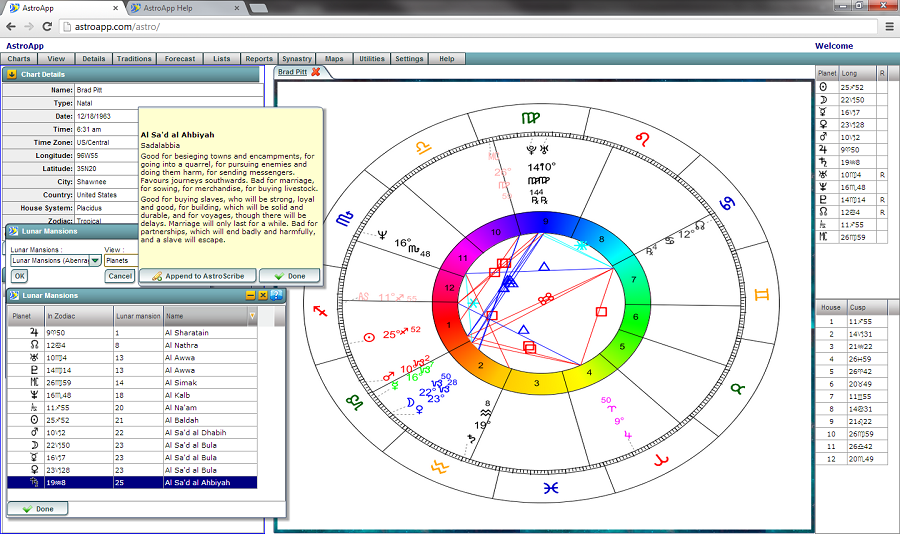
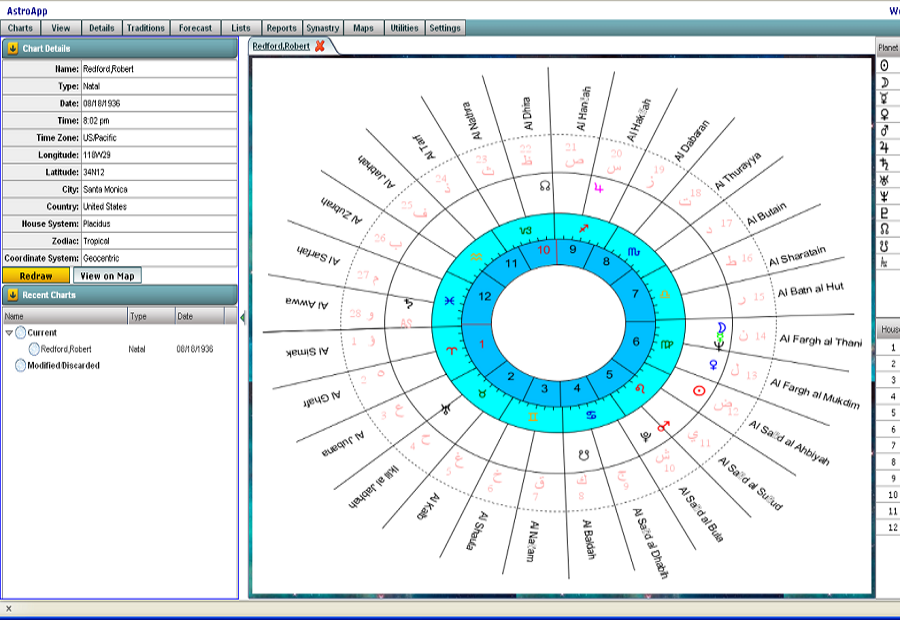
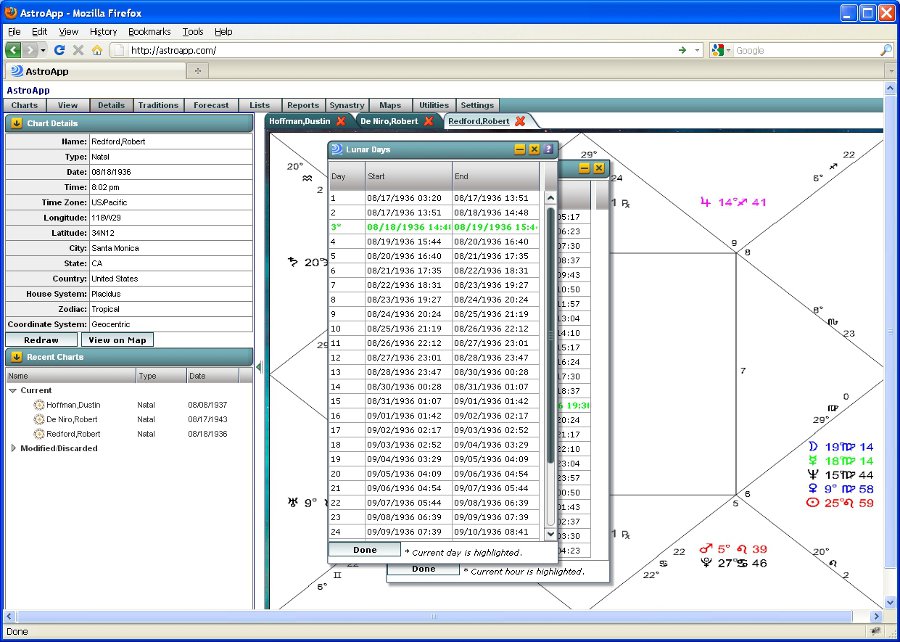
You can calculate the lunar mansions with 12 methods: tropical; sidereal, with a choice of 22 precession values; mansions defined by their stars in the Arabic, Chinese and Tibetan traditions; the Arabic manzils with the variations of Abenragel, Ibn al-Arabi, Agrippa and the Picatrix; the Vedic nakshatras; the Coptic mansions; the Chinese hsius; and the Tibetan gyukars. Each mansion comes with its description, ruler and talisman suggestions from the medieval sources. Bob Makransky's interpretations of the ingresses into the tropical mansions are also included. The lunar mansions can also be shown as a separate wheel chart style. The lunar days table shows the day of the Moon with its traditional meaning, and Michèle Raulin's 30 lunar days are listed with their times for the lunation of the chart.
Predictive Techniques
Each medieval predictive method gives you a table of the events and a timeline:
- firdaria according to al-Biruni and Schoener, Robert Zoller's variation, firdaria without the nodes, and firdaria with the lord of the turn
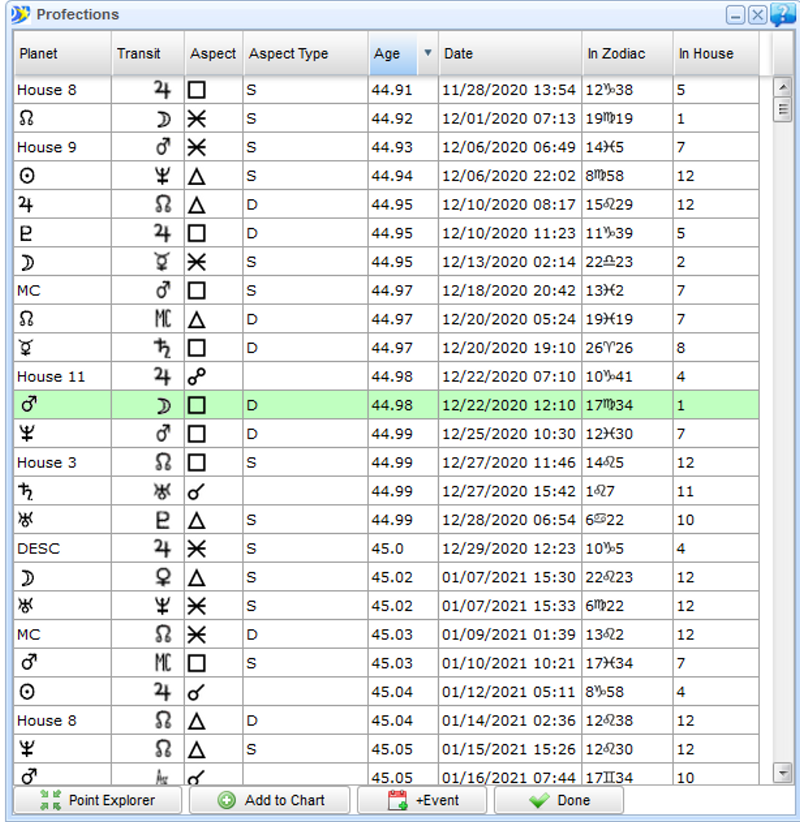
- Profections: Traditional, Manilius, Egyptian, Annual, Monthly, Daily and Hourly, with various firdaria rates, the Persian major profections, Qisma according to Abu Marwan al-Istiji and according to the Persian tradition, and the Solar Return profections, plus Umar al-Tabari's Great Condition method for the advanced profections
- Directions through the Bounds with several Arabic and Persian calculation methods, and the Solar Return Distributions
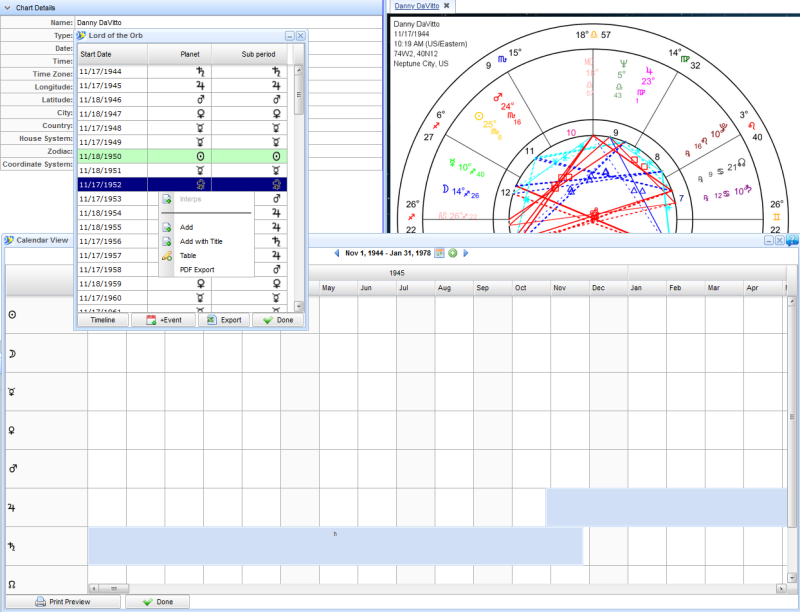
- Lord of the Turn (medieval and Egyptian variations); Lord of the Orb according to Abu Ma'shar and Diego de Torres; the Nine Parts according to Abu Ma'shar and other ancient astrologers
- five methods of Monthly Divisions
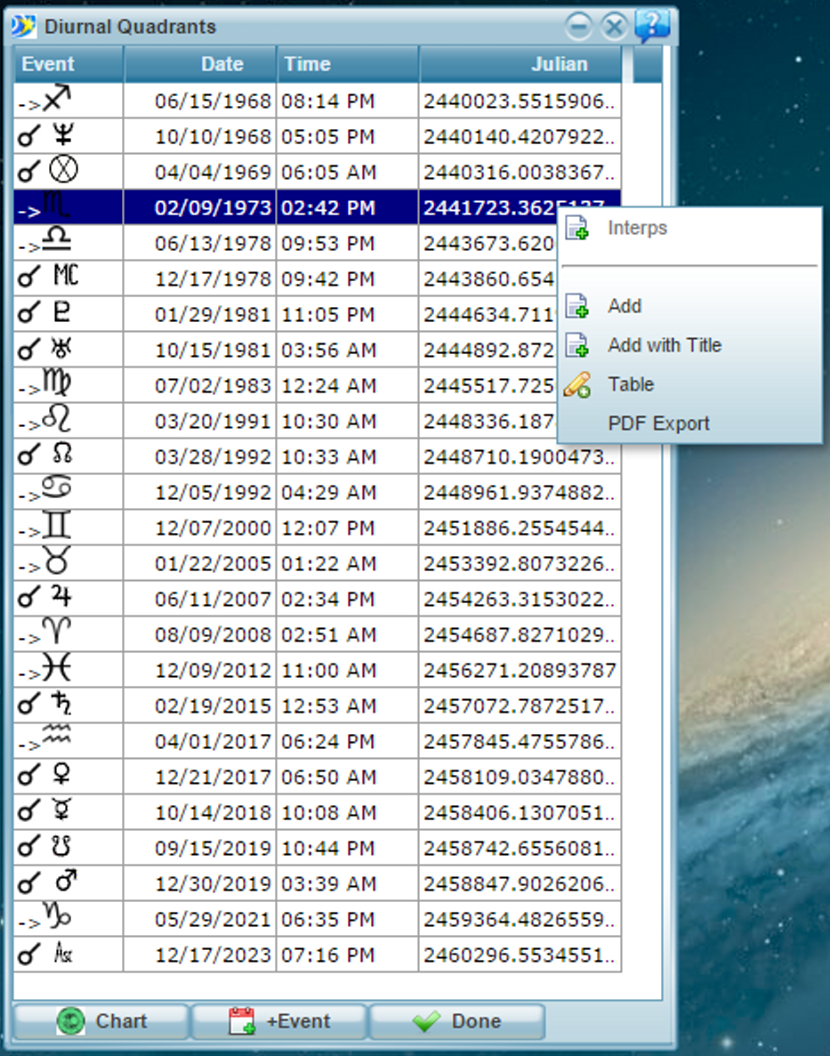
- diurnal quadrants according to Bonatti and William Lilly, among others
- time maps you can configure to combine these methods with the Hellenistic and Vedic time lords
Charts, the Traditional Page and Elections
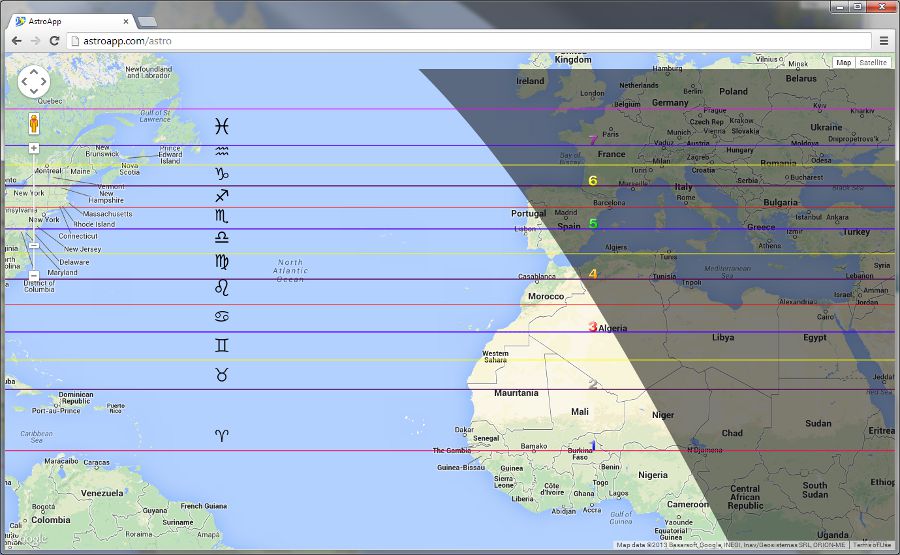
The traditional chart types include the antiscion and contra-antiscion charts, the prenatal lunation, epoch charts based on the Trutine of Hermes, derived houses and the thema mundi. You can use the medieval square chart styles or the dignities, bounds and lunar mansion wheel styles. The Traditional Page shows the chart, the dignities, the receptions, the mansions and the planetary hours on one screen, together with the election module. You can also show the Ptolemaic climes and Bonatti's chorography on the map. You can learn more about elections, including the fixed star election module for the Picatrix and Renaissance magic courses, in Electional Astrology.
Astrological Magic
The astrological magic tradition is covered by unique modules such as the Zodiacal Spirit Names, the Level of Being calculations, the Spheres of the World, the Planetary Hours, the Arabic Lunar Mansions (with the interpretations according to various medieval authors), and the Geomancy module.
Frequently Asked Questions
Which terms systems can I use?
You can choose from 10, including Egyptian, Chaldean, Valens, Hephaistio, Vedic, the Iberian variation and Ptolemy's terms (in several variations).
Can I define my own almutens?
Yes. With the Almuten Designer you can build almutens for any topic you choose, using hundreds of factors: planets, dispositors, house cusps, Arabic parts and much more.
Which firdaria methods can I use?
You can calculate firdaria according to al-Biruni and Schoener, Robert Zoller's variation, the version without the nodes, and firdaria with the lord of the turn. You can further modify each time lord method by choosing the modern year or one of the traditional year durations.
Do I get interpretations of the lunar mansions?
Yes. Each mansion has its description, ruler and talisman suggestions from the medieval sources, and the ingresses into the tropical mansions come with Bob Makransky's interpretations.
How many Arabic parts can I use?
More than 150 predefined parts from the Hellenistic, Arabic and Persian traditions. With the Arabic Parts Editor you can also define your own.
See Also
- Tutorial 6: Traditional Basic edition, an introduction
- Hellenistic Astrology, Horary Astrology and Electional Astrology
- Margherita Fiorello and The critical degrees, an article by Bob Makransky