Modern Astrology Tools
All standard astrology features and various schools of modern astrology, from Uranian and Huber astrology to Rudhyar's methods, sidereal astrology, and more.
AstroApp supports all main schools of modern astrology, including Uranian astrology of the Hamburg School, Huber astrology, Dane Rudhyar's work, Sidereal astrology and Gauquelin's research, among others. AstroApp also includes harmonics, declination techniques, a wide range of house systems, the hypothetical planets and the Dark Stars. You can switch between schools and methods and compare results with a couple of clicks.
House Systems
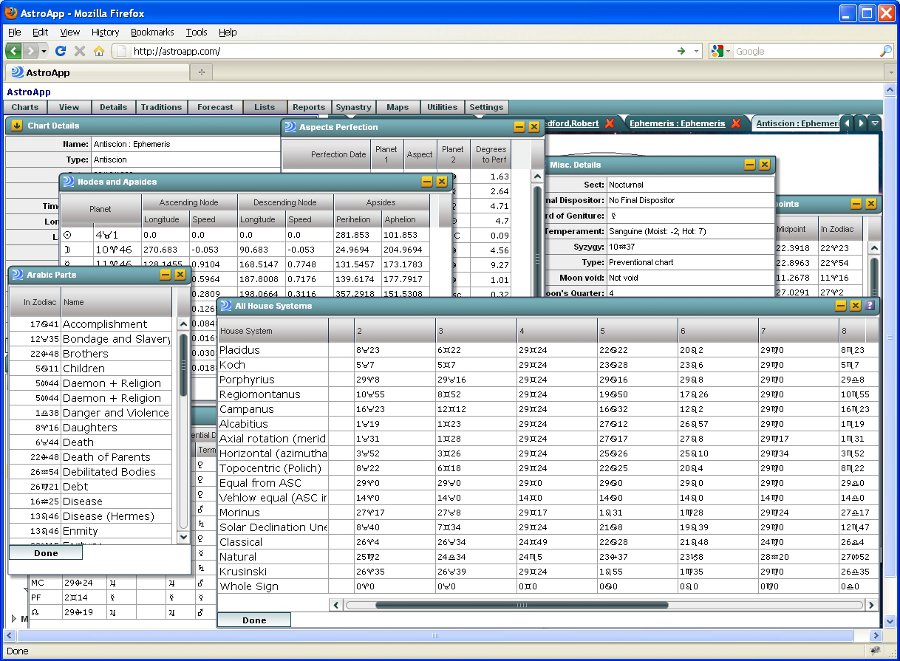
All major house systems are supported, including Placidus, Koch, Regiomontanus, Campanus, Porphyry, Alcabitius, Morinus, Meridian, Whole Sign and Equal, along with a wide range of rare and obscure ones:
- Krusinski, Abenragel, Vehlow, Sripati and the Vedic houses
- Charles Carter's Poli-Equatorial houses, M-houses, MC Whole Sign, Levitsky's MC-Mirror houses and the Decanate houses
- Equal houses from the Vertex, from the Equatorial Ascendant and from the Polar Ascendant
- unique 8 house and 13 house systems
You can also compare planets' placements in various house systems on a single screen.
Uranian Astrology and Midpoints
You can add the eight planets of the Hamburg School, Cupido, Hades, Zeus, Kronos, Apollon, Admetos, Vulkanus and Poseidon, to any chart or table. The Uranian tools include:
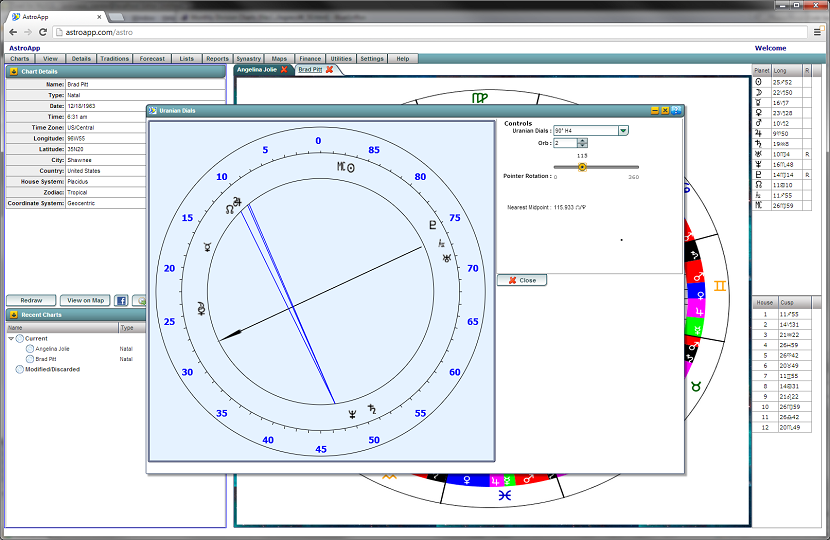
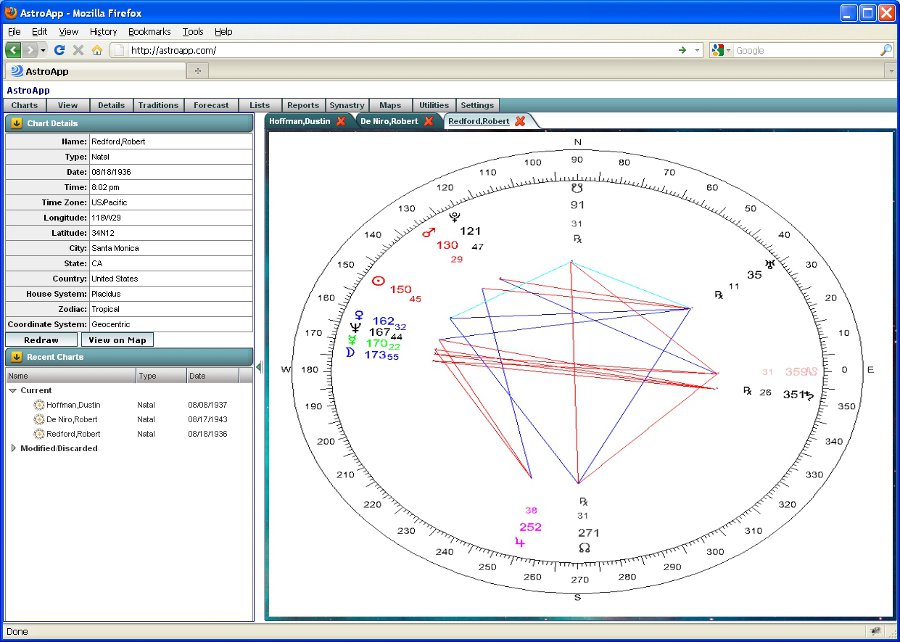
- Uranian dials with pointers and midpoints
- midpoint trees, with your choice of modulus and orb
- planetary pictures (A/B = C and A/B = C/D) on the 90°, 45° and 22.5° dials, with a formula solver
- midpoint aspects, and midpoints in mundo and in equatorial and horizontal coordinates
- planetary sums in longitude, Right Ascension, declination, mundo and azimuth
- midpoint and sum lines on AstroCartography and geodetic maps
Aspect Tools
Basic aspect tools:
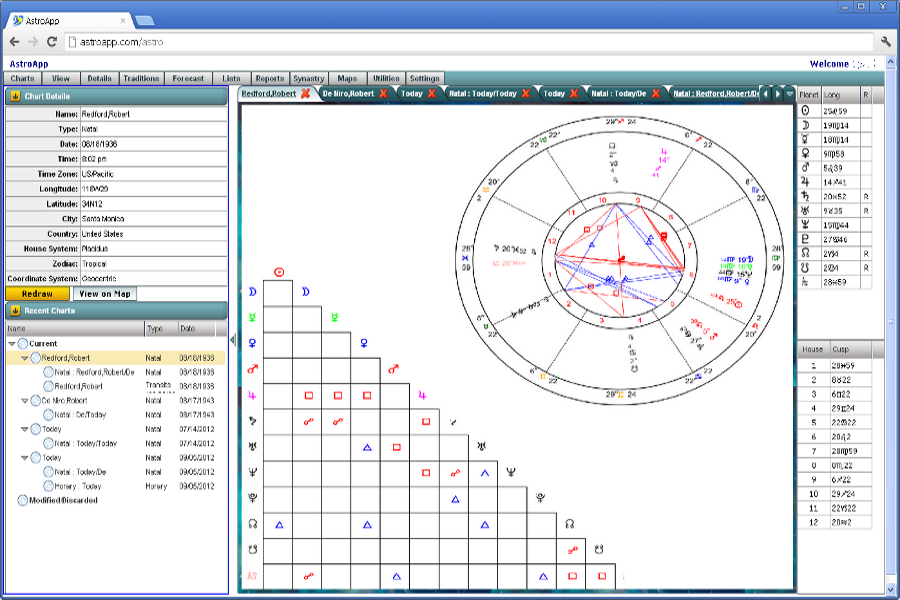
- the Aspects Grid, the Aspects and Distances table, and aspects between charts
- applying and separating aspects, aspect strength, and highlighting by orb
- orbs and moieties, aspect sets, and user-defined aspects
Advanced aspect tools:
- whole sign aspects, and in mundo aspects in 11 house systems
- aspect perfections
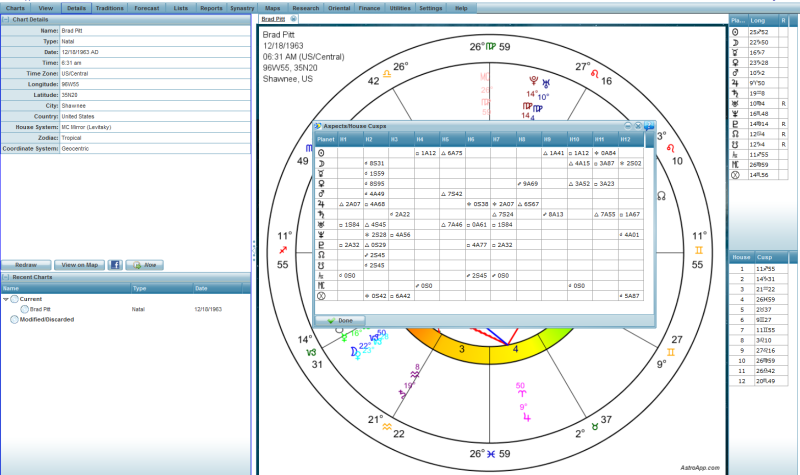
- aspects to house cusps and to fixed stars
- the Bindu table of partile aspects
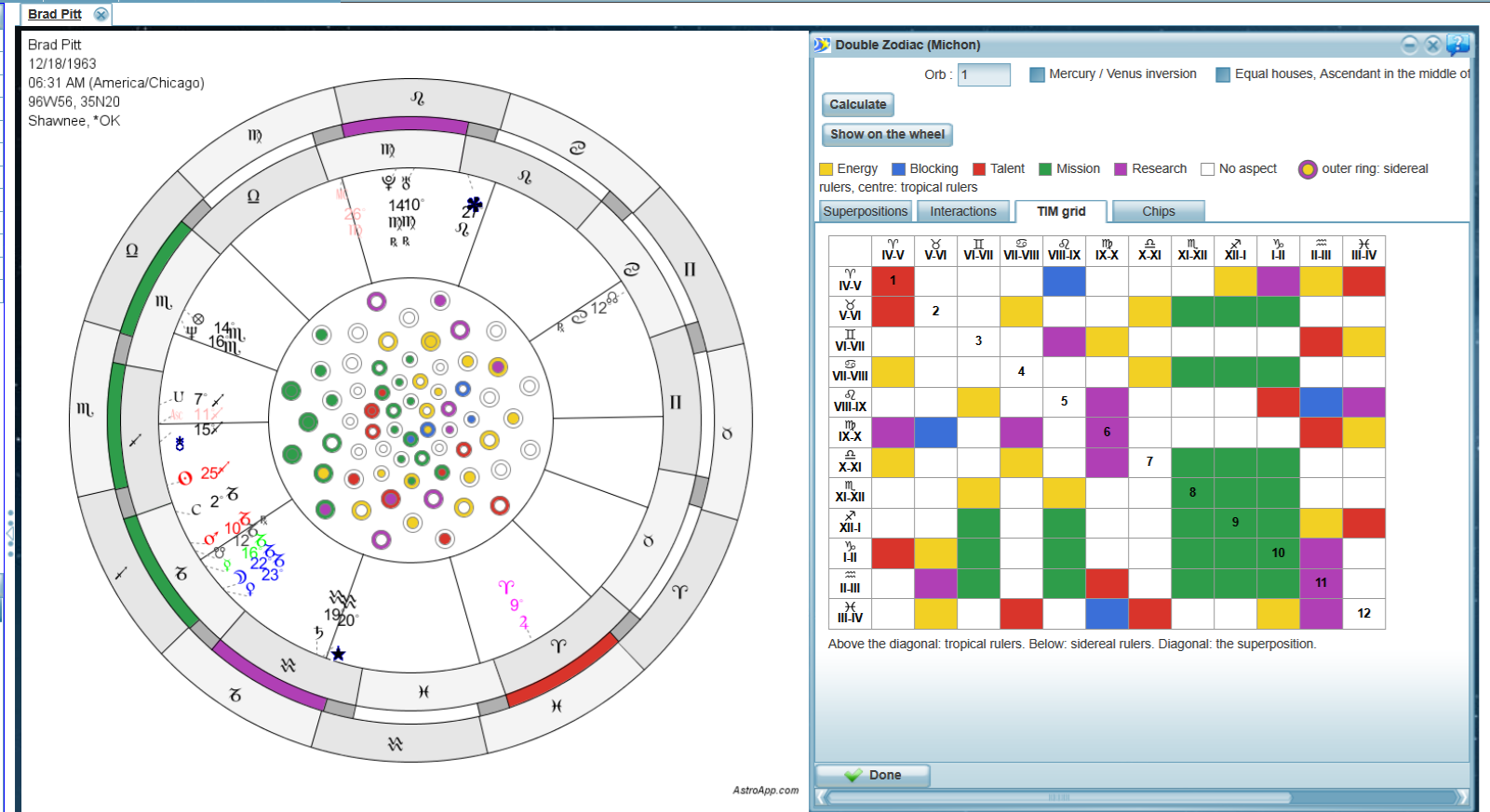
- Jean-Paul Michon's Double Zodiac, which shows how the tropical and sidereal signs overlap, on the chart and in the TIM grid
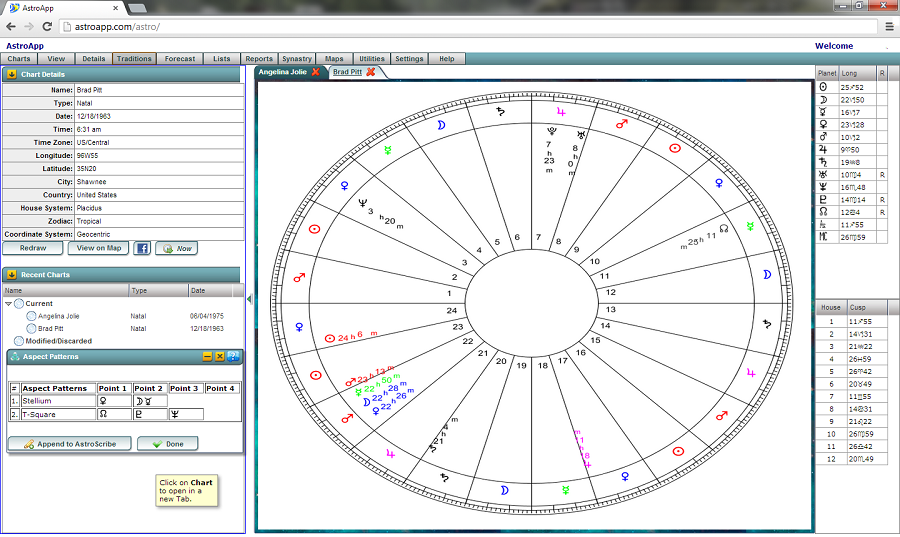
- 34 aspect patterns, from stelliums, T-squares, grand trines and yods to the kite, the mystic rectangle, Thor's hammer, the star of David and the four Huber learning patterns
AstroApp finds every aspect pattern in a chart and lists them in a table. Additionally, you can search your chart databases using aspect pattern criteria.
Huber Astrology
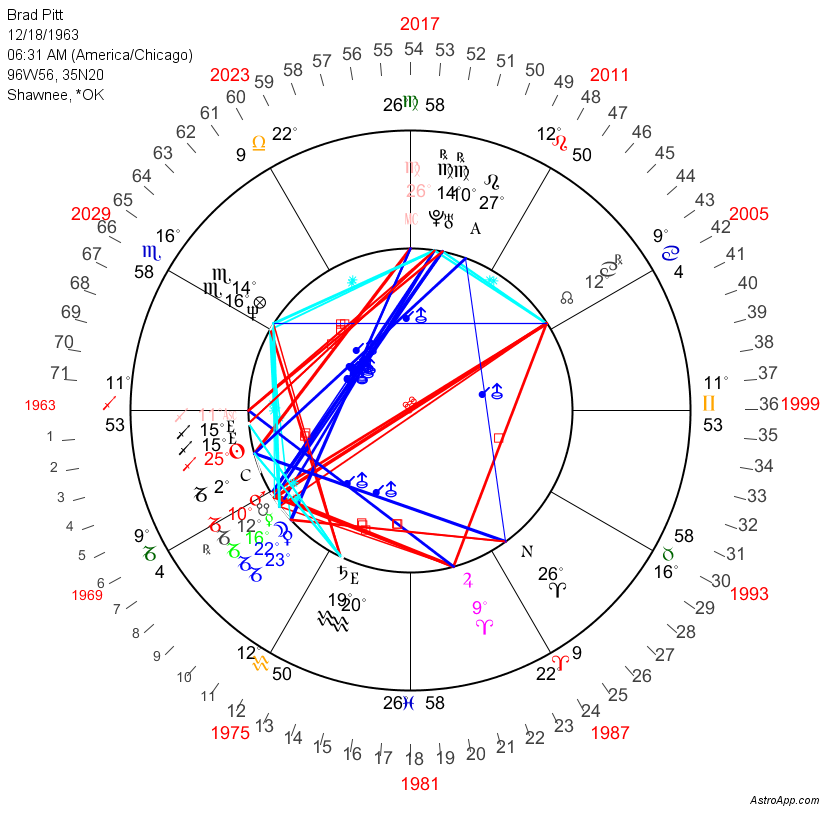
All the chart styles used in Huber astrology are supported, including the Huber radix chart, the houses chart and the lunar nodes chart. For forecasting work you can use the Huber age point: a table of date hits, the age point chart and the lunar age point. The Age Point method is not limited to the Ascendant: any point can be selected. The four Huber learning patterns are part of the Aspect Patterns module.
Gauquelin Sectors
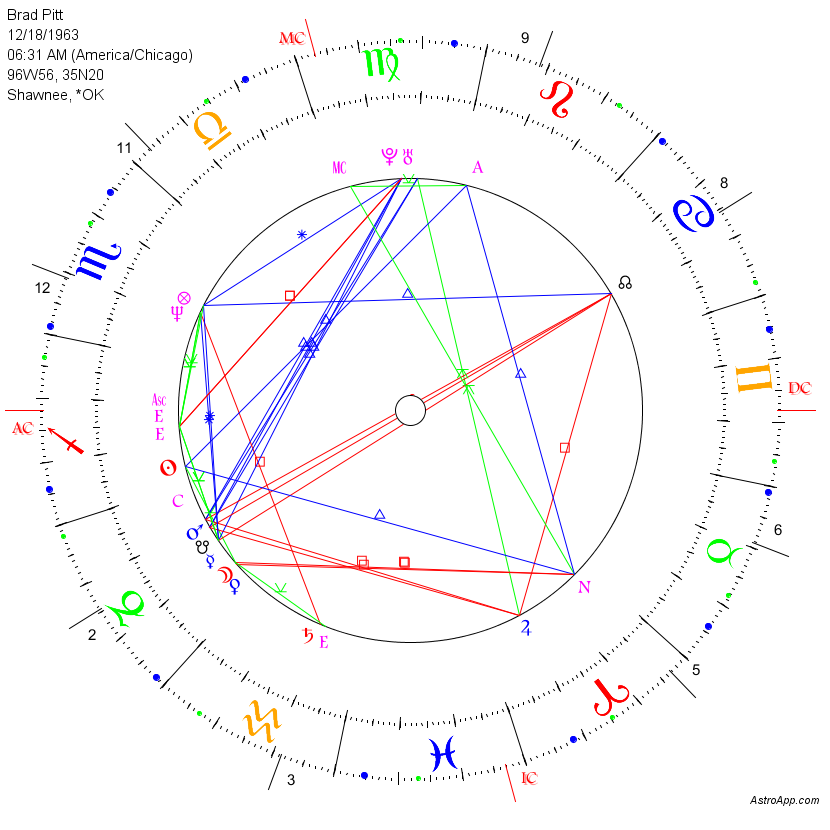
The Gauquelin Sectors chart is based on Michel Gauquelin's statistical research. It divides the chart into the Gauquelin sectors and highlights the planets in the key sectors that Gauquelin identified in his work.
Rudhyar's Quadrants and Ages
Dane Rudhyar developed his Quadrants system as a predictive technique that follows the stages of life through the four quadrants of the chart. AstroApp shows them in the Rudhyar Quadrants chart and the Rudhyar Ages table. Rudhyar's Progressions are also included in the Forecasting tools.
Sidereal Astrology
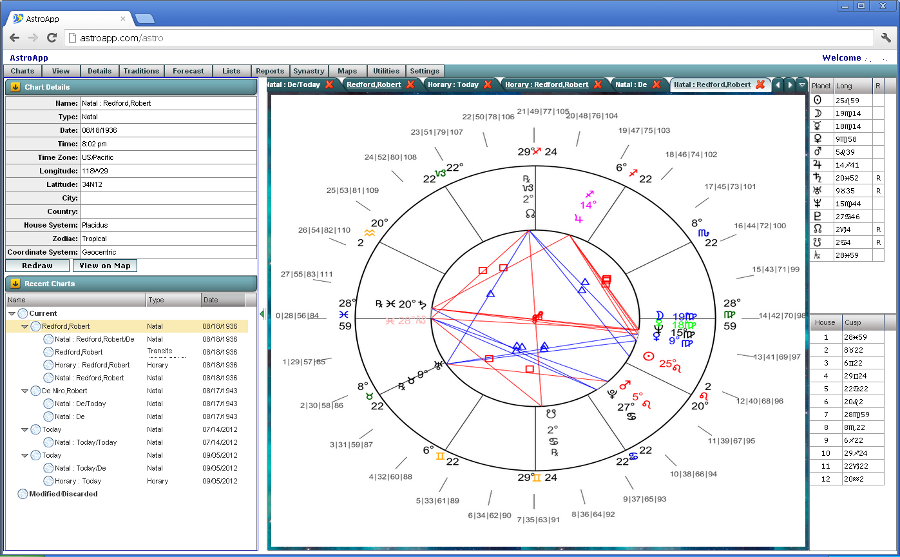
You can calculate any chart in the sidereal zodiac. Choose from more than 40 ayanamsas, including Fagan-Bradley, Lahiri, De Luce, Raman and Nick Fiorenza's, or enter your own (user-defined) values. The sidereal tools include Cyril Fagan's Novenic chart, precessed progressions, and precessed, sidereal, kinetic, phase and converse Returns.
Sidereal settings can also be used when exploring more traditional techniques, such as Hellenistic and Medieval astrology.
Hypothetical and Dwarf Planets, Dark Stars
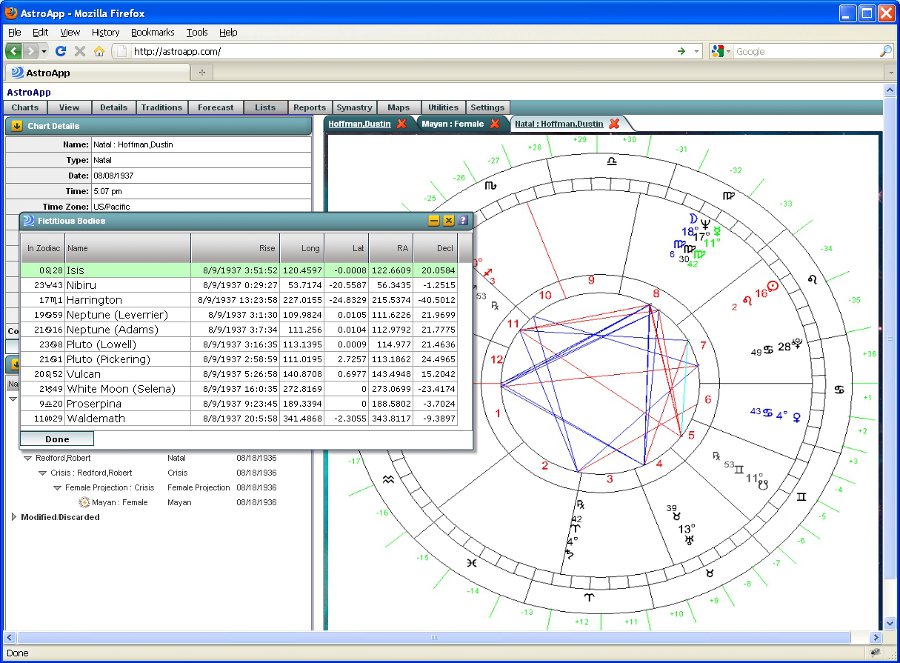
Besides the Hamburg planets, AstroApp calculates the fictitious and hypothetical bodies of several other schools. You can add each of them to charts and tables, or show them in a separate table. All points can be calculated in the Tropical zodiac, in the Sidereal zodiac and in the 13 Signs zodiac:
- Isis, Nibiru, Harrington, Leverrier's and Adams' Neptune, Lowell's and Pickering's Pluto, Vulcan, the White Moon Selena, Proserpina and Waldemath
- Phaethon, the planet believed to have broken up into the asteroid belt
- Persephone, Hermes and Demeter of the WvA school
- the dwarf planets Sedna, Makemake, Haumea and Eris, and hundreds of thousands of asteroids and Kuiper belt objects
- special points: the Vertex, Koch's Equatorial Ascendant and Co-Ascendant, Munkasey's Co-Ascendant and Polar Ascendant, and the Nonagesimal MC and IC
You can calculate charts with the Dark Stars of all the major planets, along with 20 related points, including three versions of Lilith, Priapus and the Dark Stars of the major asteroids.
Declination
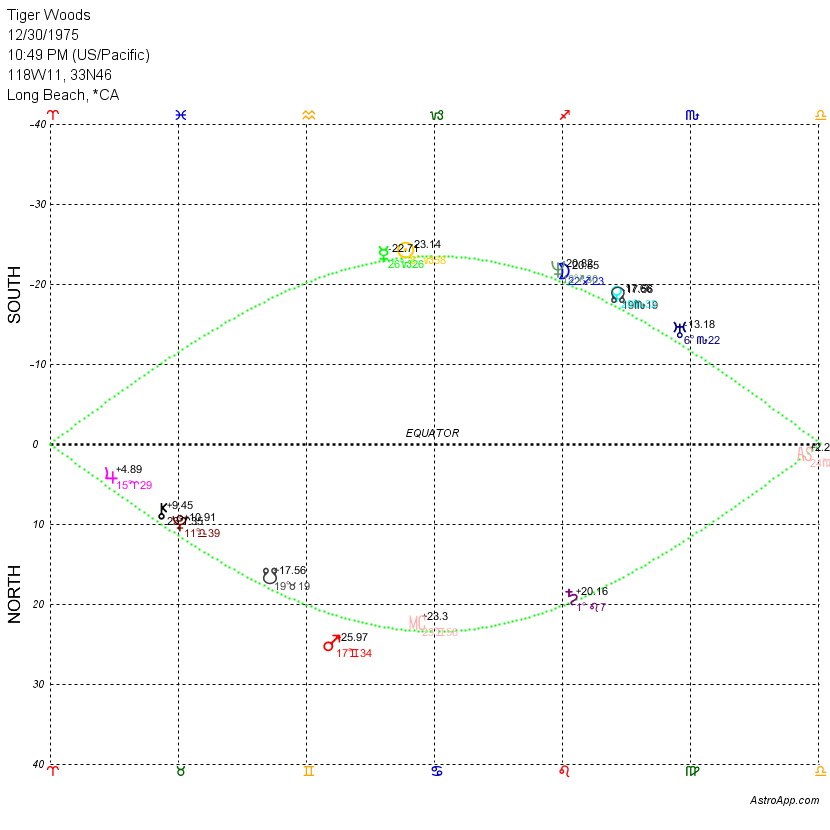
Kt Boehrer's work is represented by the Declination Diagram and its table. Charles Jayne's work is represented by his progressions in declination, and by solar and planetary arcs in declination, following the method of Charles Jayne and Eleanor Heseltine. You also get a declination chart style and midpoints in declination.
Generalized Planetary Hours
Bob Makransky's Generalized Planetary Hours system places each planet by the planetary hour it occupies. AstroApp draws the chart and calculates aspects and hour distances for every object. It also finds aspect patterns, dispositor chains with their Chaldean order numbers and corresponding chakras, and mutual receptions by hours and by signs. Bi-wheels and synastry aspects are available too, using either the Topocentric or the Campanus method.
You can learn more about this method here: Bob Makransky's Generalized Planetary Hours System.
Locational Astrology
You can relocate a chart to any place with a couple of clicks. The following relocation techniques are supported: natal chart relocation, Johndro charts in longitude and in Right Ascension, and Geodetic charts. The Relocation Finder searches the world for the places that meet your criteria. For more on Astro Geography techniques, see AstroCartography and Astro Maps.
Other Charts and Techniques
AstroApp also includes many other modern chart types and techniques:
- planet-centered charts for every planet, and asteroid-centered charts for more than 100,000 asteroids, with draconic, planet-based and asteroid-based zodiacs
- harmonics: regular, age and age-plus-one harmonics, two types of planetary arc harmonics, and a table of all harmonic positions
- persona charts, draconic charts, equilibrium and superimposed charts, and planetary nodes, aphelion, perihelion and descending node charts
- Golden Section charts, based on the work of Larisa Kolesova
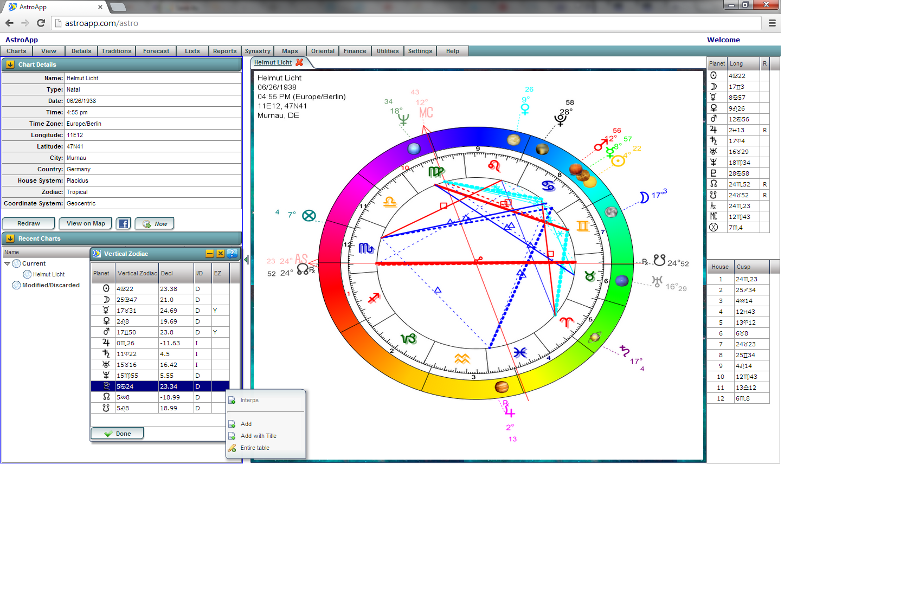
- the Decanate chart and the Vertical Zodiac chart and table, according to Helmut Licht
- the Tobey secondary chart
- the Tree of Life in the traditional, modern, esoteric and hierarchical rulerships, and Castanier's Septenary diagram
- eight types of transformation chart, including antiscion and declination charts and the harmonic arc transformation
- epoch charts based on the Trutine of Hermes, including Alexander Marr's modification of the method
- the prenatal lunation chart
- the Local Horizon chart
- the Dirah Academy's planetary strength, Western and Vedic, as tables and graphs
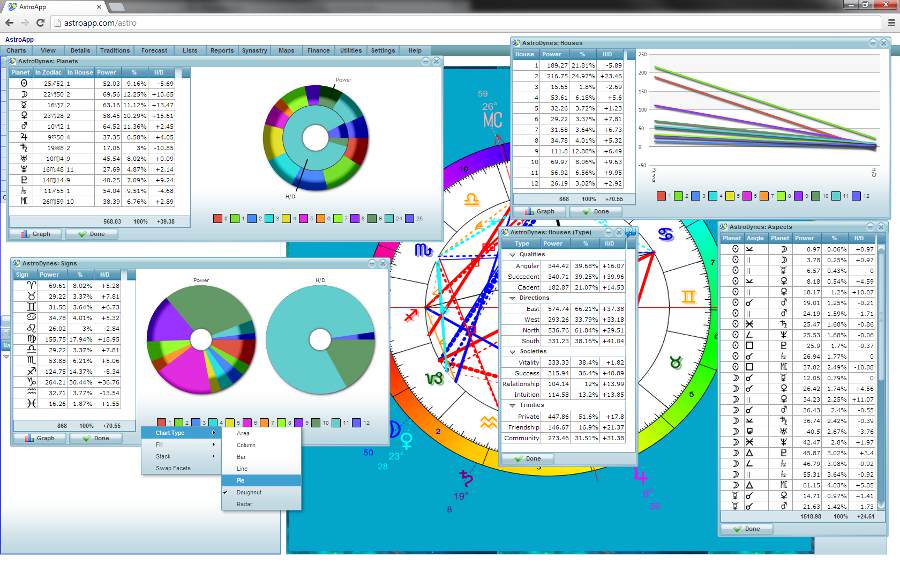
- AstroDynes, also called CosmoDynes: the strength scores of the planets, signs and houses, with graphs and statistics, plus a predefined Page dedicated to AstroDynes
Frequently Asked Questions
Which house systems can I use?
All the major ones, from Placidus and Koch to Regiomontanus and Whole Sign, plus many rare ones such as Sunshine, Poli-Equatorial houses, M-houses and Vehlow. You can also compare the placements of all planets and objects in every house system in a single table.
Can I use the Uranian planets and dials?
Yes. You can add the eight Hamburg planets to any chart and work with dials, midpoint trees, midpoint aspects and planetary sums.
Can I work in the sidereal zodiac?
Yes. Choose from more than 40 ayanamsas or enter your own precession values, and use them in every chart, forecasting tool or table.
Can I search for aspect patterns?
Yes. You can search your charts for any of the 34 aspect patterns available.
Which hypothetical planets can I add to a chart?
The Hamburg planets, the WvA planets, Isis, Nibiru, Harrington, Leverrier's and Adams' Neptune, Lowell's and Pickering's Pluto, Vulcan, Selena, Proserpina, Waldemath, Phaethon and the Dark Stars, plus the dwarf planets and asteroids.
See Also
- Generalized Planetary Hours, an article by Bob Makransky
- Tutorial 4: the vertical zodiac chart and Tutorial 2: aspects
- Chart styles, Forecast tools and Maps