Babylonian Astronomy
The night sky mapped through ancient Babylonian cuneiform texts and early astronomical predictions.
The Babylonian Astronomy module lets you view any chart exactly as ancient observers would have recorded it on clay tablets. Powered by the same birth data as your Western chart, it generates four key traditional tables: the path of Anu, Enlil, or Ea each planet occupies; the meridian-crossing Ziqpu stars; the planets' risings, settings, and stations, with planets listed by their ancient names; and the Goal-Year cycles used to predict celestial events. This feature is included in both the Pro and Financial Gold editions.
The Paths of Anu, Enlil and Ea
In Babylonian astronomy (MUL.APIN), the night sky is split into three celestial paths dedicated to three primary deities:
- Path of Enlil: the northern band (summer sun)
- Path of Anu: the central band near the celestial equator (equinox sun)
- Path of Ea: the southern band (winter sun)
The software calculates which path the Sun, Moon, Mercury, Venus, Mars, Jupiter, and Saturn occupy at your specified chart time, listing their declination and distance from each boundary. Following modern academic consensus, path boundaries are set at roughly 17° N and 17° S. Celestial bodies near these thresholds are marked as transitioning toward the adjacent path rather than firmly placed in one.
The Ziqpu Star Clock
Ziqpu is the Akkadian word for a star's culmination, its highest point as it crosses the meridian. Babylonian observers kept a list of stars in the Path of Enlil, and the one standing "in the middle of the sky" told them which stars were rising and setting that night. They counted the time between two of them in UŠ, 4 minutes each, and in bēru of 30 UŠ, 2 hours.
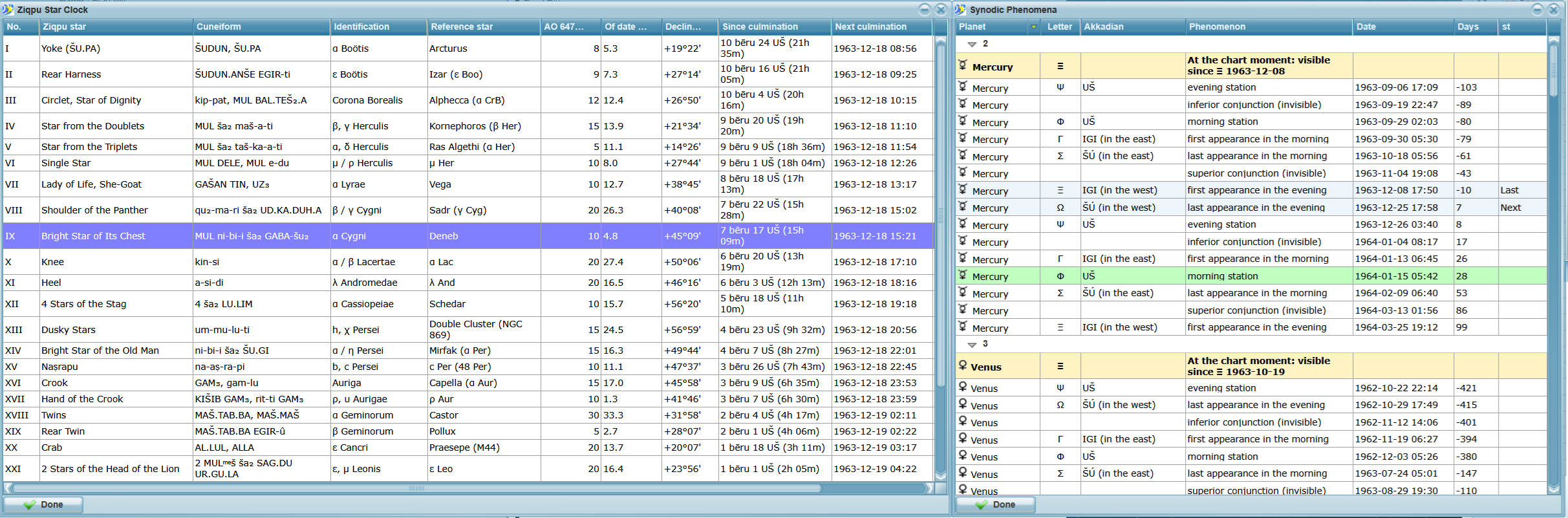
AstroApp uses the 26 stars of the tablet AO 6478, the most complete ziqpu list, from the Yoke in Boötes through Hercules, Lyra, Cygnus, Perseus, Auriga, Gemini and Leo, and back to the Harness. For the chart's time and place you get:
- the ziqpu star in the middle of the sky, and how long ago it culminated in bēru and UŠ
- the next star to culminate, and the local time of every star's next culmination
- each star's name in English and in cuneiform, and the modern stars it refers to
- the interval the tablet gives between each star and the one before it, compared with the actual interval in the sky on the chart's date
- each star's declination
Synodic Phenomena
Unlike modern astrology, which measures planets by zodiacal degrees, ancient Babylonian Astronomical Diaries tracked a planet's journey by key phases in its solar cycle: its first morning appearance, its stationary points, and its final evening visibility. AstroApp calculates these exact phenomena for Mercury, Venus, Mars, Jupiter, and Saturn across the full cycle before and after your chart, displaying both modern scholarly abbreviations and original Akkadian terms:
- Morning First Appearance (Γ / IGI) and Evening Last Appearance (Ω / ŠÚ)
- First and Second Stations (Φ and Ψ / UŠ)
- Evening First Appearance (Ξ) and Morning Last Appearance (Σ) (inner planets: Mercury and Venus)
- Oppositions and Solar Conjunctions (outer planets: Mars, Jupiter, and Saturn, including periods when hidden by solar glare)
For each planet, the table highlights its current state at the moment the chart is cast, whether it was visible or hidden, and identifies the specific event that initiated that state. First and last visibility depend on the latitude of the chart, so the same moment can give different dates in Babylon and in London.
Goal-Year Periods
In late Babylonian astronomy, forecasts for a coming year were created using observations of the planetary positions for a fixed number of years prior. The tables that contain these observation data of planetary cycles are combined in Goal-Year texts. AstroApp sets your chart date and time as the Goal Year and uses the traditional planetary periods for calculations:
- Moon: 18 years (223 lunar months / Saros)
- Mercury: 46 years
- Venus: 8 years
- Mars: 79 and 47 years
- Jupiter: 71 and 83 years
- Saturn: 59 years
For each period AstroApp shows the earlier date, the planet's position then and at the chart moment, how far it has moved against the fixed stars, and its distance from the Sun on both dates. You can also see how many synodic cycles and revolutions each period contains, which shows why these periods work: 8 years bring Venus back to its original position after 5 synodic cycles and 13 revolutions.
Frequently Asked Questions
Is this astrology or astronomy?
Both, as it was in Babylon. The tables calculate what the cuneiform texts recorded and predicted. They do not reproduce the omens of Enūma Anu Enlil, which describe things seen in the sky that no ephemeris can provide.
Why does the ziqpu list add up to 364 UŠ instead of 360?
That is the total written on the tablet AO 6478 itself. AstroApp keeps the tablet's figures and shows the actual intervals in the sky next to them.
Why are the periods given in our calendar years?
Because the Babylonian calendar was lunisolar, using years of 12 or 13 months, it fluctuates relative to our modern calendar by at most a few weeks over these long spans. The table compares these timing variations, showing just how closely each historic period aligns with your chart's exact calendar date.
Which edition includes Babylonian Astronomy?
The Pro edition and Financial Gold.
See Also
- Hellenistic astrology, the tradition that grew out of the Babylonian one
- Deep sky astrology, for the heliacal events of the fixed stars
- Mayan astrology, another ancient calendar tradition